Steel Division
In millions of euros |
|
Q 1 |
|
Q 2 |
|
H 1 |
|
|
||||||
|---|---|---|---|---|---|---|---|---|---|---|---|---|---|---|
|
|
2025/26 |
|
2026/27 |
|
2025/26 |
|
2026/27 |
|
2025/26 |
|
2026/27 |
|
Change |
|
|
04/01– |
|
04/01– |
|
07/01– |
|
07/01– |
|
04/01– |
|
04/01– |
|
|
|
|
|
|
|
|
|
|
|
|
|
|
|
|
|
Revenue |
|
1,493.8 |
|
1,530.5 |
|
1,383.0 |
|
1,300.4 |
|
2,876.8 |
|
2,830.9 |
|
−1.6 |
EBITDA |
|
189.8 |
|
218.4 |
|
206.4 |
|
187.8 |
|
396.2 |
|
406.2 |
|
2.5 |
EBITDA margin |
|
12.7% |
|
14.3% |
|
14.9% |
|
14.4% |
|
13.8% |
|
14.3% |
|
– |
EBIT |
|
126.1 |
|
153.1 |
|
143.4 |
|
121.4 |
|
269.5 |
|
274.5 |
|
1.9 |
EBIT margin |
|
8.4% |
|
10.0% |
|
10.4% |
|
9.3% |
|
9.4% |
|
9.7% |
|
– |
Employees (full-time equivalent), end of period |
|
10,586 |
|
10,753 |
|
10,670 |
|
10,862 |
|
10,670 |
|
10,862 |
|
1.8 |
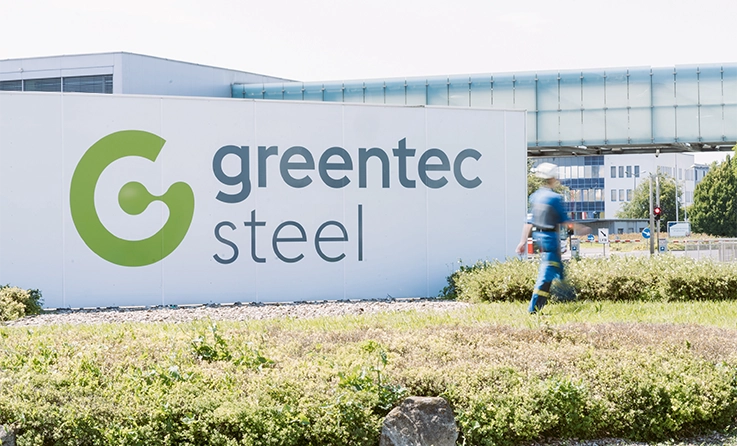
greentec steel in Linz
Next milestone for greentec steel: electric arc furnace delivered to the Linz site
Market environment and business development
Despite a persistently subdued market environment, the Steel Division posted encouraging results in the first half of the 2026/27 business year. This was primarily due to the division’s consistent focus on high-quality steel products for technologically complex applications, as well as its strong positioning as a partner to leading companies in particularly demanding industries.
Following the surge in imports in the run-up to the new EU safeguard measures and the associated build-up of inventories, import volumes declined over the course of the first half of the 2026/27 business year. At the same time, the Carbon Border Adjustment Mechanism (CBAM) increasingly demonstrated its trade protection effects and, together with the new EU safeguard measures, formed an effective protective framework against steel imports into the European Union. Despite the ongoing drawdown of elevated inventory levels and a slight seasonal decline in demand during the summer months, price trends improved in the second quarter of the 2026/27 business year.
Transport logistics posed a significant operational challenge during the reporting period. Low water levels on the Danube and restrictions on rail traffic hampered the shipment of finished products, especially since August. At the same time, higher logistics costs increased the need for price adjustments.
The Steel Division’s market segments performed as follows in the first half of the 2026/27 business year:
The European automotive industry was characterized by declining production volumes. Nevertheless, the Steel Division recorded generally satisfactory demand and maintained its strong market position. This was supported by successful price agreements and solid demand for high-quality flat steel products for specific applications.
The energy sector performed satisfactorily overall. In the first quarter of the 2026/27 business year, the market for high-quality heavy plate still benefited in part from successful project contracts concluded in the past. As the quarter progressed, however, geopolitical uncertainties in the Middle East led to delays in individual pipeline and offshore projects and, consequently, to lower earnings contributions compared with the prior year.
The construction industry remained at a low level in the first half of the 2026/27 business year. Demand remained subdued, particularly in European building construction and industrial construction. Although there were tentative signs of recovery, a sustained upturn in construction and investment activity was not yet evident.
The white goods and consumer goods industry was characterized by subdued demand for much of the period.
The mechanical engineering industry performed at a low but stable level during the reporting period. European industry’s willingness to invest remained subdued.
Financial key performance indicators
Revenue for the Steel Division declined only slightly year-over-year, by 1.6%, from EUR 2,876.8 million in the first half of 2025/26 to EUR 2,830.9 million in the first half of 2026/27. Higher price levels in the current reporting period could not fully offset slightly lower shipment volumes and a less favorable product mix resulting from delays in energy sector projects.
However, the Steel Division posted gains on the earnings side. Operating profit (EBITDA) improved by 2.5% from EUR 396.2 million (margin: 13.8%) in the first half of 2025/26 to EUR 406.2 million (margin: 14.3%) in the first half of 2026/27. The increase in the gross margin had a positive impact on operating earnings, while volume and mix trends in the current reporting period were slightly below the prior-year level. Operating profit (EBIT) increased by 1.9% year-over-year, from EUR 269.5 million (margin: 9.4%) to EUR 274.5 million (margin: 9.7%).
In a direct quarter-over-quarter comparison from the first to the second quarter of 2026/27, the Steel Division saw revenue decline by 15.0%, from EUR 1,530.5 million to EUR 1,300.4 million. While contract prices showed a positive trend, the shipment level declined due to seasonal factors and logistical challenges. Against this backdrop, the Steel Division’s EBITDA in the second quarter of 2026/27, at EUR 187.8 million (margin 14.4%), was 14.0% below the figure for the immediately preceding quarter of EUR 218.4 million (margin 14.3%). EBIT in the second quarter of 2026/27, at EUR 121.4 million (margin 9.3%), was 20.7% lower than EBIT of EUR 153.1 million (margin 10.0%) in the first quarter of 2026/27.
In terms of the number of employees (FTE, full-time equivalent), the Steel Division reported an increase of 1.8% to 10,862 (compared with 10,670 as of the same date the previous year), primarily due to preparatory measures for the commissioning of the electric arc furnace, which is scheduled for the first half of the 2027 calendar year.